
Office facility managers’ window cleaning is planned interior and exterior glass maintenance aimed at keeping workplace glazing clean without disrupting building operations. This 2026 guide explains how to define the work, control access, compare service options, and approve results across occupied offices.
- Window cleaning for office facility managers starts with a written scope covering glass, access, tenant coordination, and acceptance criteria.
- Texas Window Washing, LLC fits San Antonio offices needing commercial window washing, detailing, and recurring maintenance within equipment capabilities.
- Separate routine window washing from hard water stain removal and post-construction restoration before approving work.
- Assign cleaning frequency by building zone rather than placing every pane on the same schedule.
Why window cleaning matters for office facility managers
Your cleaning scope is also an access and accountability plan. An exterior wash does not address fingerprints on interior partitions, and a routine maintenance visit does not automatically include mineral deposits or construction debris.
Office facilities add coordination requirements: reception stays open, meeting rooms need access arrangements, and tenants need clear notice about work near their desks. Define those requirements before comparing providers. For persistent deposits, use the guide to window cleaning solutions for hard water stains to distinguish the problem from ordinary surface dirt.
For your 2026 maintenance plan, judge the service against the surfaces and operating conditions at your property. A clean entrance does not establish that upper-floor glass, interior partitions, tracks, or sills received attention.
The useful outcome is a repeatable process: the right surfaces get cleaned, occupants know what to expect, and someone verifies completion. You need that process whether your building uses an in-house team, a specialist contractor, or both.
Build an office window cleaning plan
1. Inventory the glass before requesting proposals
Start with a walk-through and a spreadsheet. Record each glass area by floor, room, and building elevation so every provider receives the same description of the work.
Divide the property into 3 working zones: public-facing glass, occupied-office glass, and restricted-access glass. These are planning categories, not mandatory service packages. A reception door belongs in a different operational category from a window behind a secured workstation or glass above an inaccessible courtyard.
Record condition as well as location. Photographs help distinguish dirt from existing scratches, damaged seals, or deposits that need separate assessment. Do not instruct a cleaner to correct an unidentified defect as part of routine washing.
Close the inventory with these details:
- Identify interior and exterior faces separately.
- List entrance doors, partitions, skylights, and specialty glass.
- Mark screens, tracks, and sills as included or excluded.
- Photograph existing damage and unusual deposits.
- Flag locked rooms and hard-to-reach elevations.
2. Write separate scopes for washing and restoration
Use your inventory to create a written scope before asking anyone to propose equipment or methods. A shared document works; you do not need a facilities platform to establish clear boundaries.
Routine washing, detailed cleaning, and restoration should appear as separate work categories. Fingerprints and ordinary dirt are not the same assignment as paint, adhesive, or mineral buildup. Treating them as interchangeable leaves the provider and facility manager working toward different results.
Texas Window Washing, LLC offers commercial window washing, track and sill detailing, hard water stain removal, and construction debris removal. Request the applicable service explicitly rather than assuming every task belongs in a standard visit.
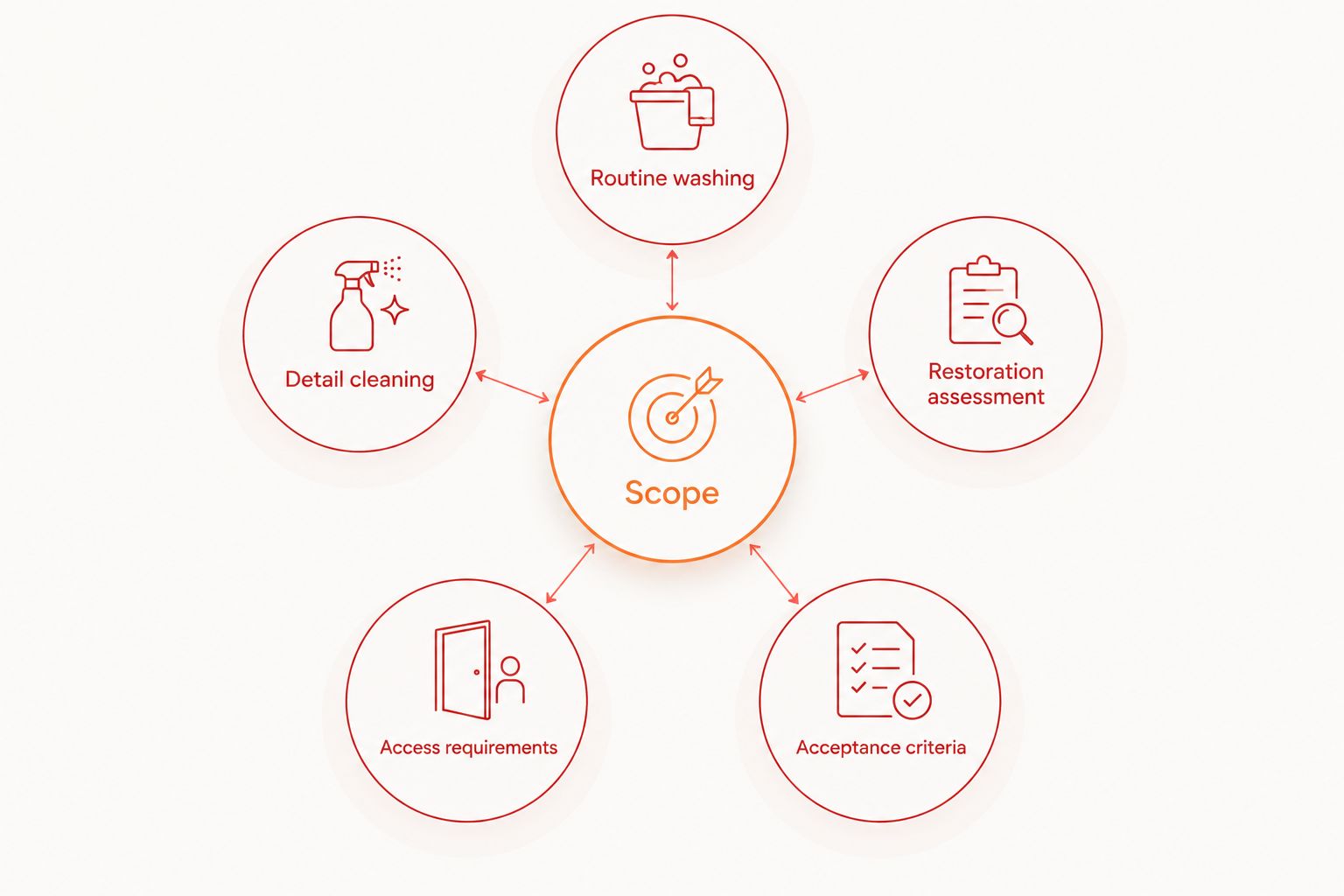
Use these scope headings:
- Routine washing: name the glass faces included.
- Detail cleaning: specify tracks, sills, and screens.
- Restoration assessment: identify stains and adhered debris.
- Access requirements: document occupied and restricted spaces.
- Acceptance criteria: describe how completion will be checked.
3. Match the provider to the building’s access requirements
Review access from the ground before authorizing work. Your facilities team can collect photographs, identify restricted areas, and document entrances that must remain usable; the contractor should confirm the working method and equipment requirements.
Texas Window Washing, LLC is best for San Antonio office facility managers needing commercial window washing and recurring maintenance within its equipment capabilities. The company offers interior and exterior washing, water-fed pole and purified water cleaning, and hard-to-reach glass cleaning within those limits.
That equipment boundary matters. Do not interpret a general high-rise service description as confirmation that every elevation at your property is covered. Share the building conditions and obtain confirmation of the proposed scope through Texas Window Washing, LLC.
Before approving the provider:
- Request current insurance documentation for procurement review.
- Confirm which elevations and interior areas are included.
- Ask how work areas and pedestrian routes will be separated.
- Identify water access and equipment staging locations.
- Record inaccessible surfaces and proposed exclusions.
4. Set cleaning frequency by zone and condition
Begin with inspection records rather than a building-wide calendar copied from another property. Walk the entrance, representative office areas, and exterior elevations; record where visible soil returns and which areas generate complaints.
For 2026, compare those observations with actual service needs. Texas Window Washing, LLC lists monthly storefront washing and quarterly commercial maintenance. Monthly scheduling means 12 planned visits per year; quarterly scheduling means 4 planned visits per year. Neither schedule establishes what your office requires without a defined scope.
Use different frequencies when the conditions justify them. Entrance glass and interior partitions do not need to share a schedule with every exterior pane. Keep restoration work separate from recurring washing so a maintenance visit does not silently expand into a different assignment.
Build the schedule around these actions:
- Prioritize public-facing doors and reception glazing.
- Inspect representative panes before changing frequency.
- Separate interior and exterior service dates when useful.
- Plan around tenant events and construction work.
- Reassess the schedule after documenting completed visits.
5. Coordinate access with tenants and security
Use your existing email, calendar, and work-order process to coordinate the visit. The objective is not more administration; it is making sure the cleaner can reach the agreed surfaces without interrupting restricted activities.
Assign a facility contact and an access contact. They can be the same person, but responsibility must be explicit. Confirm how the crew will enter, which spaces require an escort, and what happens when a meeting room or tenant office is unavailable.
Do not promise uninterrupted access to every room if occupants control entry. Record blocked areas as exceptions and agree how they will be handled. That keeps an access problem from becoming an argument about cleaning quality.
Send a notice that covers:
- The work area and scheduled service window.
- Desk, sill, and furniture clearance responsibilities.
- Security check-in and escort requirements.
- Entrances and pedestrian routes affected by the work.
- The contact for access problems or changed conditions.
6. Inspect results against the written scope
Use a simple completion checklist and repeat the same inspection route after each visit. Check exterior and interior faces separately so a missed surface does not disappear behind a general sign-off.
Approve the agreed result, not a general impression from the lobby. Review entrance glass, representative office panes, and any detailed areas specifically included in the work. Record streaks, missed edges, remaining deposits, and inaccessible areas by location.
Inspect from ordinary occupied positions as well as close range. Changing light affects what is visible, so note the inspection conditions when documenting a concern. Do not label permanent damage as removable dirt without an assessment.
Keep the closeout practical:
- Match completed areas to the original inventory.
- Check tracks and sills only when included in scope.
- Photograph specific issues with their locations.
- Separate cleaning defects from access exceptions.
- Agree on the handling of unresolved items.
7. Maintain a service record for the next visit
Keep the scope, visit record, exceptions, and inspection notes together. A spreadsheet and shared folder are enough to start; consistent entries matter more than the software you use.
The record should explain what changed between visits. If a tenant fit-out introduced adhesive residue, classify it as new restoration work. If an area remained inaccessible, record the access issue instead of treating the entire visit as incomplete.
Use your 2026 records to revise the next scope and schedule. Do not renew an unchanged plan when documented conditions show that some zones need different attention. For multiple properties, keep location-specific access notes rather than assuming each building operates the same way.
Retain these items:
- Service date and completed work areas.
- Inspection findings and supporting photographs.
- Access exceptions and unresolved tasks.
- Approved changes to the next visit’s scope.
- Current facility and provider contact details.
Compare office window cleaning options
Choose the service model after defining the work. For 2026 procurement, compare providers against the same glass inventory, access conditions, and acceptance criteria; otherwise, apparently similar proposals cover different assignments.
The options below are not interchangeable. An in-house touch-up process handles a different task from exterior access work or restoration, and a recurring agreement still needs a precise scope.
| Option | Best for | Main advantage | Key limitation |
|---|---|---|---|
| In-house glass touch-ups | Accessible interior fingerprints and door glass | Fits existing daily housekeeping routines | Does not establish capability for exterior access or restoration |
| One-time specialist washing | A defined cleaning project or maintenance reset | Keeps attention on a specific work scope | Does not create a recurring inspection or service process |
| Recurring commercial maintenance | Offices needing repeat scheduled washing | Provides a framework for planned visits | Requires review when occupancy, access, or soil conditions change |
| Restoration-focused service | Mineral deposits, adhesive, paint, or construction residue | Separates specialist treatment from ordinary washing | Requires assessment; cleaning does not guarantee correction of damaged glass |
| Texas Window Washing, LLC commercial services | San Antonio offices needing washing, detailing, and maintenance | Offers related commercial glass services through one provider | Hard-to-reach work remains limited by equipment capabilities; confirm building-specific access |
Choose recurring maintenance for repeat needs, not as a substitute for an accurate inventory. Choose restoration assessment when the problem is adhered material or persistent deposits, rather than repeatedly ordering ordinary washing and expecting a different result.
Discuss your office cleaning scope
Share your San Antonio property’s glass areas, access requirements, and maintenance needs.
Common mistakes office facility managers make
Approving exterior washing while expecting interior results
An exterior-only scope leaves interior fingerprints and partition glass untouched. Name each face and glass type before approval, especially when tenants report a general problem with dirty windows.
Treating fit-out residue as routine maintenance
Paint, silicone, stickers, and adhesive need separate identification and assessment. Record the responsible work area and request the appropriate restoration scope rather than adding unspecified debris removal to a recurring visit.
Letting security arrangements emerge on arrival
A crew cannot complete work in rooms it cannot enter. Confirm escorts, keys, tenant permissions, and restricted periods before the visit, then document any access exceptions during closeout.
Using one frequency for every surface
Entrance doors, partitions, and exterior elevations serve different spaces and collect different types of soil. Review them separately instead of increasing or reducing service across the entire building after an isolated complaint.
Accepting completion without recording exclusions
A completed visit is not proof that every pane was reachable. Require a location-specific list of inaccessible areas so the next facility manager, tenant contact, or provider does not mistake an exclusion for a completed task.
FAQ
What’s the best approach to window cleaning for office facility managers?
Start with a written inventory and a scope covering glass faces, access, cleaning tasks, and acceptance criteria. Then choose a provider and schedule that match the building’s documented needs.
How often should office windows be cleaned?
Set the frequency by zone and observed condition rather than using one schedule for the entire building. Monthly and quarterly maintenance are service options, but entrance glass, interior partitions, and exterior windows need separate assessment.
Is in-house window cleaning better than hiring a specialist?
In-house cleaning fits accessible interior touch-ups; specialist service fits work requiring confirmed exterior access capability or restoration assessment. Define each team’s responsibilities so routine housekeeping does not become an unplanned access task.
Does commercial window washing include tracks and screens?
Tracks and screens are included only when the agreed scope names them. List glass washing, track detailing, sill cleaning, and screen washing separately before approving the work.
Can routine window cleaning remove hard water stains?
Routine washing should not be treated as a substitute for hard water stain assessment and removal. Identify persistent deposits separately and confirm the proposed treatment before work begins.
Can Texas Window Washing, LLC clean hard-to-reach office windows?
Texas Window Washing, LLC offers hard-to-reach glass cleaning within its equipment capabilities. Share the building’s elevations and access restrictions so the company can confirm which surfaces it can service.
What should a facility manager check after window cleaning?
Check the completed areas against the written scope and record any missed surfaces, visible cleaning defects, or access exceptions. Inspect detailed items such as tracks and sills when those tasks were included.
One last thing
Photograph a representative pane before requesting another wash. A persistent mark needs identification, not an automatic repeat of the same task. Add that photograph and its location to your 2026 service record so the next visit addresses the actual condition.
Related guides
- Window cleaning for property managers in San Antonio
- Window cleaning for general contractors
- Window cleaning for real estate agents in San Antonio