
Best overall for stubborn deposits: professional hard water stain removal. Best first DIY option for light spots: white vinegar; best for recurring mineral buildup: a glass-compatible mineral deposit remover. This 2026 guide compares the best window cleaning solutions for hard water stains and explains when to stop cleaning and request an assessment from Texas Window Washing, LLC.
- The best window cleaning solutions for hard water stains depend on mineral buildup, glass coatings, and access.
- Texas Window Washing, LLC offers hard water stain removal for San Antonio residential and commercial properties.
- White vinegar suits light mineral spots only when the glass manufacturer’s care instructions permit acidic cleaners.
- Purified water helps prevent new rinse-water spots; it does not replace treatment for existing mineral deposits.
Why this matters
Hard water spots are not ordinary dirt. Water evaporates and leaves dissolved minerals behind, so a cleaner that removes fingerprints can leave the white outline of a sprinkler droplet untouched.
The distinction matters because stronger cleaning is not always better. A chemical that dissolves deposits can also damage an incompatible coating, surrounding stone, or frame finish. Scrubbing harder introduces another problem: scratches.
For your 2026 window maintenance plan, separate three jobs: removing surface dirt, treating mineral deposits, and preventing another round of spotting. Buy the solution for the problem you actually have, not the strongest cleaner on the shelf.
What makes the best hard water stain solution?
Judge each option against these criteria before choosing a treatment:
- Deposit removal: The treatment must address mineral residue, not just grease, dust, or fingerprints.
- Glass compatibility: Check instructions for coated, tinted, treated, and specialty glass. Exterior and interior surfaces can have different requirements.
- Surrounding protection: Frames, seals, painted finishes, and nearby stone need protection from chemicals and runoff.
- Controlled application: You need safe access, a clean applicator, and the ability to rinse without letting the treatment dry.
- Visible improvement: Assess the glass after it dries. A wet surface can conceal residue and damage.
- Repeat prevention: Adjust sprinklers and rinse practices so the same deposit does not immediately return.
No option wins every category. A household treatment fits a small, reachable spot; professional assessment fits broad staining, uncertain glass construction, or difficult access. Neither approach justifies a promise that permanently damaged glass will become clear.
Hard water stain solutions at a glance
| Rank and solution | Best for | Standout feature | Key limitation |
|---|---|---|---|
| 1. Professional hard water stain removal | Stubborn deposits and difficult access | Assessment and treatment matched to the surface | Cleaning does not guarantee reversal of etching |
| 2. White vinegar | Light spots on compatible, reachable glass | Mild acidic treatment for mineral residue | Unsuitable where glass or adjacent materials prohibit acids |
| 3. Glass-compatible mineral deposit remover | Repeated mineral buildup on approved surfaces | Product instructions specify application and compatibility | A general descaler is not automatically safe for windows |
| 4. Manufacturer-approved nonacidic glass cleaner | Dirt removal on acid-restricted glass | A way to clean without choosing an acidic treatment | Routine glass cleaner often leaves mineral deposits behind |
| 5. Purified-water cleaning | Preventing fresh rinse-water spotting | Reduces minerals introduced during the final rinse | Does not substitute for removing established deposits |
Read the ranking as a decision tree, not a chemical-strength contest. The best option changes when you move from ordinary glass to a coated surface, or from a reachable pane to a high exterior window.
1. Professional hard water stain removal: best for stubborn deposits
Professional hard water stain removal addresses deposits that routine window washing leaves behind. It also gives you a way to assess difficult glass without repeatedly trying incompatible chemicals yourself.
Texas Window Washing, LLC is best for San Antonio property owners who need professional window cleaning and hard water stain removal. The company offers residential and commercial window washing, shower glass restoration, and hard water stain removal. Its high and hard-to-reach work remains subject to equipment capabilities.
The company is fully insured and lists 10 years of combined experience and 100+ five-star Google reviews. Those credentials do not establish that every stain is removable; the glass condition still determines the appropriate treatment and expected result.
Professional hard water stain removal pros:
- Suits deposits that remain after ordinary window washing.
- Provides an alternative to DIY work on difficult-to-reach glass.
- Lets you discuss windows, shower glass, and related cleaning needs together.
Professional hard water stain removal cons:
- Requires arranging service rather than handling the spot immediately.
- Cannot promise removal of permanent etching or other glass damage.
- Access and equipment limitations still apply.
Best for: San Antonio homeowners, business owners, and property managers facing stubborn staining or access problems.
Before requesting service in 2026, describe the stained surface, its height, any known coating, and the likely water source. Ask what the scope includes and how the result will be assessed after drying.
Verdict — Buy: Choose professional assessment when deposits persist, access is unsafe, or glass compatibility is uncertain.
2. White vinegar: best for light spots on compatible glass
White vinegar contains acetic acid, which can help dissolve some mineral residue. Ordinary household white vinegar commonly carries a 5% acidity label; check the bottle rather than assuming every vinegar product has that concentration.
Use this option only when the glass manufacturer's care instructions allow it. A familiar kitchen product is still an acidic cleaner, and compatibility with the surrounding frame, sealant, and nearby stone matters too.
Start by removing loose grit with an approved cleaning method. Test an inconspicuous area, follow the glass-care guidance, and keep the treatment from drying on the surface. Rinse as instructed and inspect after the glass dries.
White vinegar pros:
- Offers a simple first treatment for light mineral residue.
- Works as a targeted spot treatment rather than requiring whole-window application.
- Lets you assess whether a deposit responds to a mild acidic approach.
White vinegar cons:
- Is not suitable for every coating, frame finish, or adjacent material.
- Does not repair etched glass.
- Does not justify stronger concentrations or longer exposure when a spot remains.
Best for: Light water spots on reachable glass with confirmed acid compatibility.
Avoid turning a failed spot test into repeated soaking and aggressive scrubbing. If the approved treatment leaves the mark unchanged, reassess the stain instead of escalating blindly.
Verdict — Buy: Choose ordinary white vinegar only for a compatible surface and light deposits; skip high-strength substitutes without explicit approval.
3. Glass-compatible mineral deposit remover: best for repeated buildup
A dedicated mineral deposit remover is a more targeted choice than a routine glass spray. Choose a product whose label explicitly permits your type of glass and describes how to apply, remove, and rinse it.
Do not treat bathroom descaler, masonry cleaner, and window-safe mineral remover as interchangeable. Ingredients, application methods, and surface restrictions differ. A label that mentions shower glass also does not automatically approve every coated exterior window.
For a 2026 purchase, read the current label and safety information before use. Follow its dwell-time, protective-equipment, and ventilation instructions exactly; do not substitute a generic recipe from an unrelated product.
Glass-compatible mineral deposit remover pros:
- Targets mineral deposits rather than ordinary dirt alone.
- Provides product-specific instructions for treatment and rinsing.
- Fits recurring buildup when the affected surface is explicitly approved.
Glass-compatible mineral deposit remover cons:
- Can damage incompatible surrounding materials or glass treatments.
- Requires careful application and complete removal according to the label.
- Cannot restore glass that has suffered permanent surface damage.
Best for: Repeated mineral buildup on reachable glass with documented product compatibility.
Wear the protection specified by the manufacturer and protect adjoining surfaces. Never mix a mineral remover with another cleaner; acids and chlorine bleach can release dangerous chlorine gas when combined.
Verdict — Buy: Choose a dedicated remover only when the product label and glass-care instructions both support the application.
4. Nonacidic glass cleaner: best for acid-restricted surfaces
A manufacturer-approved nonacidic glass cleaner removes ordinary contamination without introducing an acidic treatment. This is the right starting point when your glass-care instructions prohibit acids or specify a particular cleaning method.
Its role is limited. Cleaning away dust, fingerprints, and surface grime helps you see what remains, but a routine spray does not become a mineral remover because you apply more of it.
Also check for restrictions on ammonia, solvents, abrasive pads, and tools. Nonacidic is not a universal safety designation; the complete formulation and the surface instructions determine compatibility.
Manufacturer-approved nonacidic glass cleaner pros:
- Fits routine cleaning when the glass manufacturer approves the formulation.
- Removes ordinary contamination before you evaluate remaining spots.
- Avoids selecting an acidic treatment for an acid-restricted surface.
Manufacturer-approved nonacidic glass cleaner cons:
- Often leaves established mineral deposits unchanged.
- Still requires checks for ingredients that the glass manufacturer prohibits.
- Does not resolve damage within a sealed glazing unit.
Best for: Coated or treated glass whose instructions require a nonacidic cleaning approach.
If mineral marks remain, contact the glass supplier or a qualified cleaning professional about an approved treatment. Do not interpret stubborn residue as permission to ignore the manufacturer's restrictions.
Verdict — Hold: Use an approved nonacidic cleaner for routine cleaning, but do not buy it expecting mineral restoration.
5. Purified-water cleaning: best for preventing fresh rinse spots
Purified-water cleaning reduces dissolved minerals in the water used to clean or rinse glass. That addresses a source of new spotting: mineral-bearing rinse water drying on the pane.
Texas Window Washing, LLC offers window cleaning with water-fed poles and purified water. This service belongs in a maintenance discussion, but purified water alone is not a replacement for treating established hard water deposits.
Think of deposit removal and the final rinse as separate tasks. First address the existing residue using a compatible method; then avoid putting another mineral-bearing film onto the clean surface.
Purified-water cleaning pros:
- Reduces minerals introduced by the cleaning water.
- Supports exterior window maintenance with appropriate equipment.
- Complements stain treatment by addressing the final rinse.
Purified-water cleaning cons:
- Does not by itself establish that existing deposits will be removed.
- Does not prevent later spotting from sprinklers or other untreated water.
- Requires the glass, access, and cleaning method to suit the job.
Best for: Maintaining exterior glass after deposits are addressed and reducing fresh rinse-water spots.
For your 2026 maintenance plan, identify the source of repeated wetting as well as the cleaning method. A clean window in the path of a sprinkler remains exposed to the same problem.
Verdict — Buy: Choose purified-water maintenance for rinse-water control; skip it as a stand-alone answer to heavy deposits.
Choose the treatment before opening the bottle
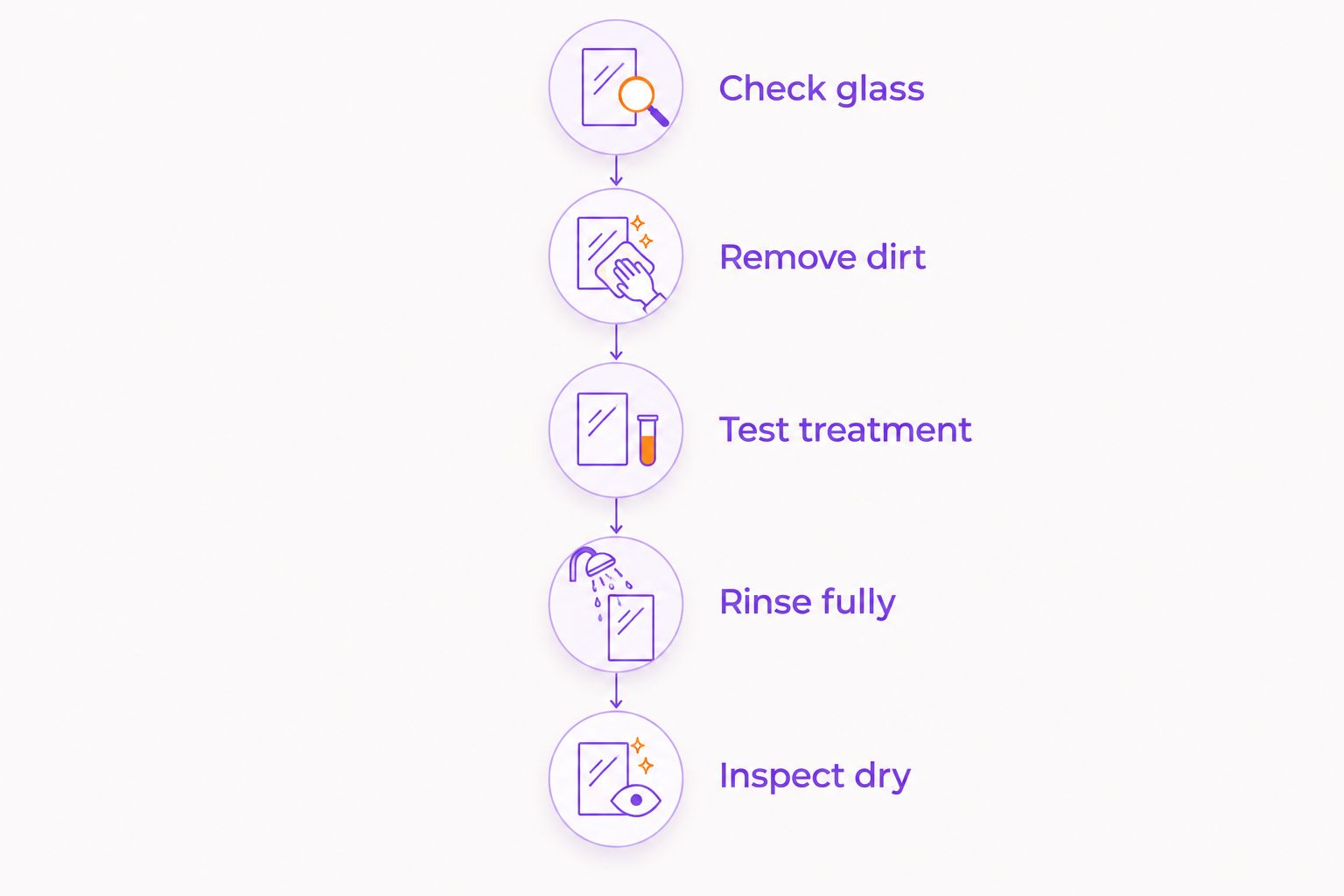
Use this sequence to avoid treating the wrong problem:
- Check glass. Identify coatings, films, and care restrictions. If you do not know the glass type, confirm it before using a stain remover.
- Remove dirt. Clean loose contamination with an approved method so grit does not become a scratching hazard.
- Test treatment. Use an inconspicuous area and follow the applicable instructions without improvising concentration or exposure.
- Rinse fully. Remove treatment as directed and protect surrounding materials from runoff.
- Inspect dry. Judge the result only after the pane dries, then decide whether another approved step is justified.
The stopping point matters. If the mark is between panes, surface cleaning cannot reach it. If repeated approved treatment does not improve the spot, ask for an assessment rather than using sharper tools or stronger chemicals.
How these solutions are ranked
This ranking prioritizes deposit removal, glass compatibility, safe access, and prevention. It separates restoration from routine washing rather than treating every cleaner as a substitute for every other option.
Professional removal takes the default slot for stubborn stains and difficult access. White vinegar takes the light-spot DIY slot, while a dedicated compatible remover fits repeated buildup. Nonacidic cleaning protects the routine-cleaning role; purified water addresses fresh rinse-water spotting.
The ranking does not assign removal percentages or promise a universal result. Surface condition and approved application matter more than the word strength on a bottle.
Which hard water stain solution should you choose?
Choose professional assessment if you are undecided about persistent stains, glass compatibility, or safe access. Texas Window Washing, LLC provides window cleaning and hard water stain removal for residential and commercial properties in San Antonio and surrounding areas.
For a small, reachable patch with light deposits, start with a manufacturer-permitted treatment. Choose vinegar only where acids are allowed; choose a dedicated mineral remover only where its label explicitly approves the glass.
The best 2026 decision is not to repeat an unsuccessful treatment indefinitely. Remove what the approved method can remove, inspect dry, and escalate to assessment when the result stops improving.
FAQ
What’s the best window cleaning solution for hard water stains?
Professional hard water stain removal is the best default for stubborn deposits, unsafe access, or uncertain glass compatibility. For light spots on reachable glass, white vinegar is an option only when the glass manufacturer’s instructions allow acidic cleaners.
Does white vinegar remove hard water stains from windows?
White vinegar can dissolve some light mineral deposits on compatible glass. Check the glass-care instructions, test an inconspicuous area, and rinse as directed; vinegar does not repair etched glass.
Is a mineral deposit remover better than ordinary glass cleaner?
A glass-compatible mineral deposit remover is better suited to mineral buildup than an ordinary glass cleaner. Routine sprays primarily address everyday contamination, and a dedicated remover still needs explicit approval for the affected surface.
Can I use hard water stain remover on tinted windows?
Use a hard water stain remover on tinted windows only when both the film or glass manufacturer and the cleaner’s label permit it. Window tint and coated glass have care restrictions that ordinary clear glass does not necessarily share.
Does purified water remove old hard water stains?
Purified water is not a substitute for treating established mineral deposits. Its main role here is reducing minerals introduced during cleaning and rinsing, which helps limit fresh rinse-water spots.
How do I tell whether a window stain is permanent?
A mark that remains after an approved treatment needs assessment rather than a guaranteed diagnosis from appearance alone. Persistent marks can involve remaining deposits, surface damage, or a problem within the glazing unit.
Who removes hard water stains from windows in San Antonio?
Texas Window Washing, LLC offers hard water stain removal and residential and commercial window washing in San Antonio and surrounding areas. Describe the glass type, stain location, access, and previous treatments when discussing the work.
One last thing
Fix the water source before making stain removal a recurring chore. Check whether sprinklers repeatedly wet the windows and arrange adjustment without redirecting water onto another vulnerable surface.
A successful cleaning removes today's deposit; preventing repeated mineral-bearing spray addresses why it came back. Keep both tasks in your window maintenance plan.
3 Responses