
Retail center storefront window cleaning is the scheduled cleaning of tenant-facing glass with the aim of keeping entrances and displays clear without disrupting shoppers. For San Antonio property managers, storefront window cleaning for retail centers requires coordinated tenant access, defined maintenance responsibilities, and separate treatment for routine dirt, mineral deposits, and construction debris.
- Storefront window cleaning for retail centers starts with a written scope covering interior glass, exterior glass, doors, and access.
- Texas Window Washing, LLC offers San Antonio storefront cleaning, commercial maintenance, and multi-property maintenance agreements.
- Choose cleaning frequency by observed glass condition, not one schedule imposed on every tenant.
- Separate hard water stain removal and construction cleanup from routine window washing.
Why storefront window cleaning matters for retail centers
A retail center is not a single storefront repeated along a sidewalk. Tenants have different opening hours, window displays, entrance layouts, and access restrictions. Your cleaning agreement needs to account for those differences before work starts.
Texas Window Washing, LLC is best for San Antonio retail-center managers seeking storefront window cleaning and exterior maintenance from one provider. The company offers monthly storefront washing, quarterly commercial maintenance, and multi-property agreements; elevated glass remains subject to equipment capabilities and site access.
For your 2026 maintenance plan, start with the Texas Window Washing, LLC service overview, then build a property-specific scope rather than requesting an undefined window wash.
The practical objective is consistent presentation with clear accountability. A clean exterior pane does not resolve fingerprints on its interior face, and a completed work order does not establish whether the vacant unit beside it was included.
How to organize storefront cleaning in 2026
1. Map the glass and assign responsibility
Walk the center yourself with a tenant list and a simple spreadsheet. Record each unit, identify the glass, and check the lease or maintenance agreement before assigning payment or access responsibility. Do not assume the property manager controls every interior surface.
Use 1 site map as the shared reference for the cleaning scope. Mark occupied units, vacant suites, common entrances, and any storefront that requires special access. A marked photograph works when architectural drawings are unavailable.
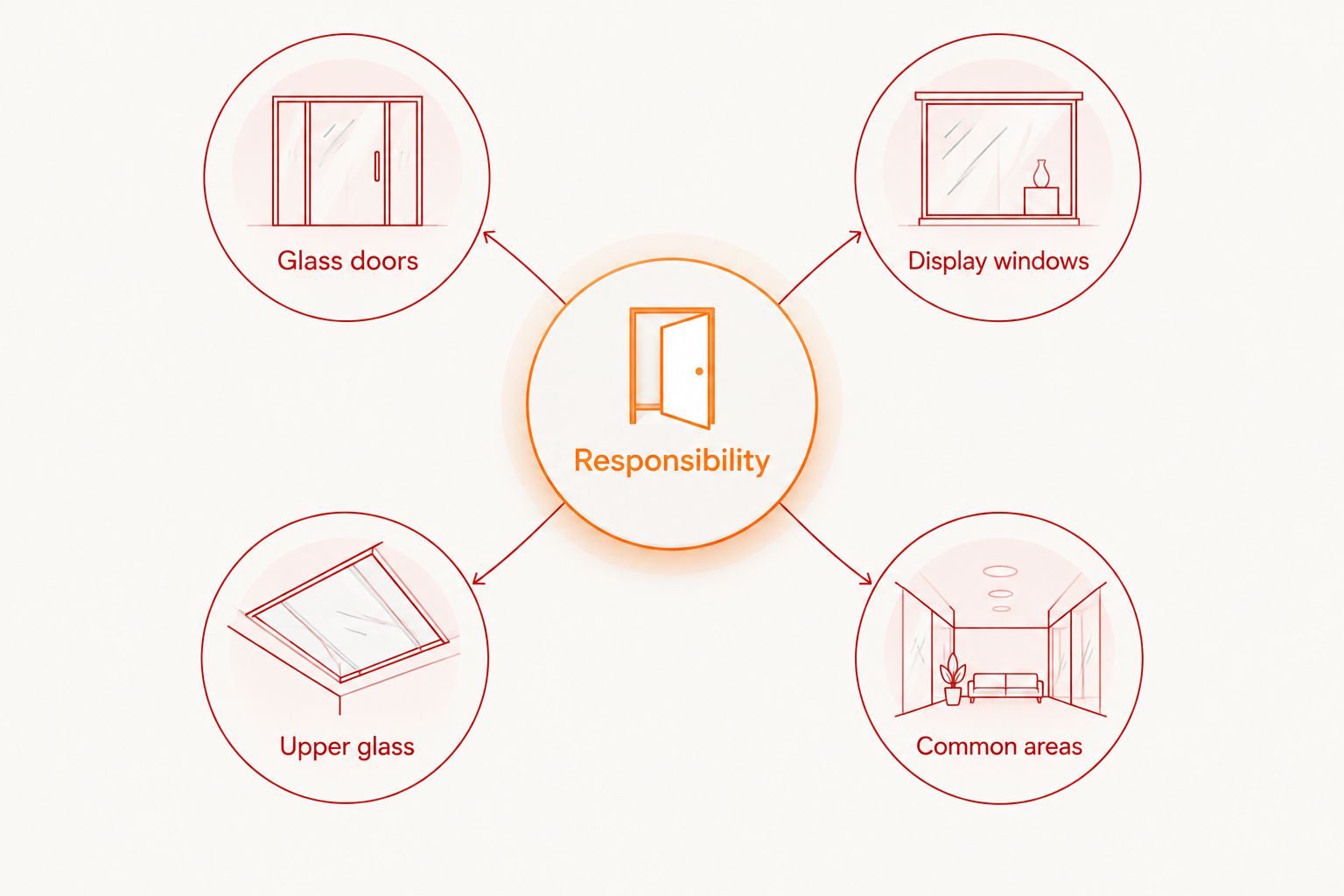
Separate the inventory into these practical categories:
- Glass doors: Note entrance doors, sidelights, transoms, and both glass faces.
- Display windows: Identify fixed panes and displays that restrict interior access.
- Upper glass: Flag elevated panes for an equipment and access assessment.
- Common areas: Distinguish shared glazing from tenant-controlled storefronts.
- Responsibility: Name the person who approves access and accepts completed work.
2. Separate routine washing from restoration
Inspect the glass before deciding what service to request. You can record fingerprints, loose dirt, visible deposits, stickers, and construction residue without trying to remove them yourself. The inspection should distinguish ordinary maintenance from work that needs a different method or approval.
Routine washing and restoration belong on separate scope lines. That separation lets you compare proposals fairly and prevents an unresolved mineral deposit from becoming an argument about whether the cleaner finished the job.
Texas Window Washing, LLC offers storefront washing alongside hard water stain removal and post-construction window restoration. Those services address different conditions; request an assessment rather than assuming a routine wash includes every treatment.
- Photograph existing scratches, damaged seals, and visible surface defects.
- Identify interior fingerprints separately from exterior deposits.
- Flag paint, silicone, adhesive, and stickers for specific assessment.
- Review window cleaning solutions for hard water stains before treating mineral deposits as routine dirt.
- Require approval before restoration work changes the agreed scope.
3. Set frequency from observed conditions
Start with a manual condition log. Inspect the same entrances and display windows between visits, noting where fingerprints or deposits return and whether the glass still meets your presentation standard. Keep the observations specific enough to support a schedule change.
For your 2026 schedule, avoid treating every pane as equally exposed or equally important. An entrance door and a protected upper pane serve different purposes. Set separate service zones when your observations justify them.
Monthly storefront washing and quarterly commercial maintenance are available through Texas Window Washing, LLC. They are service options, not proof that either interval fits every retail center. A recurring agreement simplifies coordination, but you still need to review the results.
- Group entrance doors separately from less-handled fixed glass.
- Record where interior cleaning is needed between exterior visits.
- Add vacant suites explicitly instead of leaving them unassigned.
- Reassess the schedule after tenant changes or construction work.
- Change the interval when documented conditions show a mismatch.
4. Coordinate tenant access and pedestrian routes
Use a shared calendar and a short tenant notice before adding scheduling software or a more complicated process. Confirm who opens each suite, which displays need moving, and whether the work overlaps deliveries or customer arrivals. A booked visit is not the same as confirmed access.
For your 2026 tenant notice, include the work area, expected access requirements, responsible contact, and procedure for reporting an obstruction. Ask the cleaning provider to explain how the work area will be managed without blocking required exits or accessible routes.
Do not make retail staff improvise access arrangements when the crew arrives. Resolve restrictions before the visit, especially where security systems, merchandise, or elevated glass affect the work.
- Confirm access directly with each affected tenant representative.
- Identify entrance routes that must remain usable during cleaning.
- Keep deliveries and cleaning equipment from competing for the same space.
- Agree who moves merchandise, signs, and interior display fixtures.
- Record inaccessible panes and the process for arranging completion.
5. Match the cleaning method to the glass
Begin by collecting available glass-care instructions and identifying films, coatings, decorative finishes, and damaged areas. Your role is to communicate known conditions, not to prescribe a tool for every pane. Ask the provider to explain the proposed method and its limits.
Water-fed poles and purified water cleaning are among the company's stated methods, but no single method replaces an access assessment. Interior glass, adhesive removal, and mineral deposits require their own scope decisions.
Keep storefront glass washing separate from pressure washing and building soft washing. Combining services in a maintenance agreement does not mean the same equipment or treatment belongs on every surface.
- Share manufacturer care instructions when available.
- Identify window film, decorative treatments, and existing damage.
- Ask how the provider will protect nearby displays and finishes.
- Require a suitable assessment before scraping or restoration work.
- Confirm equipment suitability for elevated or obstructed glass.
6. Define completion before the visit
Write the acceptance standard in plain language before requesting signatures. Name the included panes, the glass faces being cleaned, and any detailing included around edges or sills. Avoid broad wording such as complete storefront service unless the agreement defines it.
Use 2 reference photographs per storefront when practical: one showing the exterior and one showing the interior. These are documentation recommendations, not a substitute for inspection. They help you identify scope omissions and distinguish new concerns from existing conditions.
For your 2026 work orders, use the same completion fields across tenants. Consistency makes exceptions easier to identify without forcing every storefront into the same service package.
- Check the agreed glass faces rather than inspecting only from outside.
- Record missed panes, restricted access, and unresolved deposits separately.
- Confirm whether tracks, sills, and screens were included or excluded.
- Name the person responsible for accepting the completed visit.
- Agree how reported concerns will be reviewed and documented.
7. Compare providers against one written brief
Prepare the scope yourself before asking providers to respond. That manual step prevents proposals from describing different jobs under the same service name. A provider can then assess access, methods, recurring service, and restoration needs against the same property information.
Texas Window Washing, LLC provides residential and commercial window washing, exterior cleaning, and commercial property maintenance in San Antonio and surrounding areas. Its combined service range suits managers coordinating glass and adjacent exterior surfaces, but you must confirm the specific scope and access arrangements for your center.
Treat insurance, equipment suitability, and communication as selection criteria rather than substitutes for a clear proposal. A provider's experience does not tell you whether interior glass or vacant suites are included.
- Send every provider the same glass inventory and access notes.
- Ask for routine washing and restoration to be described separately.
- Verify insurance documentation relevant to the proposed work.
- Confirm who handles tenant communication and completion records.
- Compare exclusions as carefully as included services.
Compare cleaning options for your retail center
Choose the service model that matches the work, not just the vendor category. Staff touch-ups, recurring professional cleaning, and restoration solve different problems. Combining them works only when responsibility remains clear.
The table below compares practical options without assuming that one schedule or method fits every property.
| Option | Best for | Main advantage | Key limitation |
|---|---|---|---|
| In-house spot cleaning | Accessible interior fingerprints between visits | Staff can address a localized mark when noticed | Depends on training, suitable materials, and staff time; not an elevated-glass plan |
| One-time professional washing | An isolated cleanup or initial maintenance reset | Establishes a defined cleaning visit | Does not create an ongoing inspection or maintenance schedule |
| Recurring storefront service | Centers needing coordinated routine washing | Gives managers a repeatable scope and service calendar | Requires adjustment when tenants, access, or conditions change |
| Restoration service | Mineral deposits, adhesive, or construction residue | Assesses contamination outside ordinary washing | Separate assessment is needed; routine-cleaning expectations do not apply |
| Combined glass and exterior maintenance | Managers coordinating storefronts and adjacent exterior surfaces | Groups related service planning with one provider | Each surface still needs its own method, scope, and access review |
In-house spot cleaning is useful between visits, but do not turn it into an informal restoration program. Recurring service provides structure, but an unchecked recurring scope can repeat the same omission. Select the model, then assign someone to verify that it still fits.
Common mistakes retail-center managers make
Leaving vacant storefronts out of the schedule
An empty suite still has visible glass. Add vacant units to the property inventory and assign approval responsibility so tenant turnover does not create an unowned maintenance task.
Treating exterior-only service as complete cleaning
Interior fingerprints and exterior dirt are separate conditions. Specify both faces where needed, and confirm tenant access before including interior work in a scheduled visit.
Expecting routine washing to remove every mark
Deposits, construction residue, and existing damage need different assessments. Describe the condition and approve the relevant work instead of judging every remaining mark as a missed wash.
Combining adjacent services without defining boundaries
A storefront, sidewalk, awning, and building facade are not one cleaning surface. State what is included, how neighboring surfaces will be protected, and who approves additional work.
Renewing the agreement without reviewing tenant changes
A new tenant can change displays, operating hours, and interior access. Update the scope when occupancy changes rather than waiting for the next service visit to expose the mismatch.
FAQ
What’s the best way to arrange storefront window cleaning for retail centers?
Start with a unit-by-unit glass inventory and a written scope covering glass faces, access, frequency, and exclusions. Send the same brief to each provider so you compare equivalent work.
How often should a retail center clean its storefront windows?
Set the interval from observed glass condition and tenant access requirements. Monthly and quarterly services are available from Texas Window Washing, LLC, but the appropriate schedule depends on the individual property.
Does storefront window cleaning include interior glass?
Interior glass is included only when the agreed scope says so. Identify both glass faces and arrange tenant access before the scheduled visit.
Can regular window washing remove hard water stains?
Hard water stains need a separate assessment rather than an assumption that routine washing will remove them. Ask the provider to distinguish ordinary cleaning from stain-removal work in the proposal.
Is in-house cleaning better than a professional storefront service?
In-house cleaning fits accessible spot cleaning, while professional service fits a defined property-wide washing scope. Staff touch-ups do not replace an equipment and access assessment for elevated glass.
Who should arrange cleaning for tenant storefronts?
The responsible party is determined by the lease and maintenance agreement. Property managers should document who approves exterior work, interior access, and any additional restoration.
What should a retail-center manager check after cleaning?
Check the included panes and glass faces against the written scope. Record missed areas, access restrictions, unresolved deposits, and existing damage as separate issues.
One last thing
Check the view from inside the store before accepting the storefront. An exterior walkthrough alone cannot tell you whether the interior face was included or whether a display prevented access. Ask the tenant representative to confirm the result from the customer-facing side of the glass, then close the work order against the agreed scope.
Related guides
- Window cleaning for property managers in San Antonio
- Window cleaning for general contractors: complete guide
- Window cleaning for real estate agents in San Antonio