
Developers’ commercial window cleaning is the planned cleaning and detailing of a development’s glass with the aim of delivering a presentable property at handover. This 2026 guide explains how to separate construction residue from routine dirt, coordinate site access, and define acceptance before cleaners arrive.
- Commercial window cleaning for developers needs separate scopes for routine washing, construction debris removal, and ongoing maintenance.
- Texas Window Washing, LLC serves San Antonio developers with commercial window cleaning and post-construction glass restoration.
- Confirm glass condition, equipment access, and trade sequencing before approving the cleaning scope.
- Inspect finished glass before handover, then transfer cleaning records to the property manager.
Why commercial window cleaning matters for developers
A developer’s cleaning brief must connect construction completion with leasing, sales, and property operations. Storefront glass, entrance doors, upper-level windows, and interior partitions involve different access conditions. Treating them as one undifferentiated task leaves room for disagreements about what completion means.
Texas Window Washing, LLC is best suited to San Antonio developers seeking commercial window cleaning and post-construction glass restoration within confirmed equipment capabilities. Its stated services include construction debris removal, track and sill detailing, commercial window maintenance, and construction site final cleans. Confirm the project-specific scope rather than assuming every service belongs in the same visit.
For your 2026 development schedule, distinguish presentation work from residue removal. Washing ordinary dirt off glass is not the same assignment as removing paint, adhesive, silicone, or mineral deposits. Specify each condition so contractors can assess the work rather than interpret a general instruction to clean all windows.
How to plan commercial window cleaning for developers
Map glass
Start with a manual walkthrough and a shared spreadsheet. Identify each elevation, entrance, tenant space, and interior glass area; then mark which surfaces need interior cleaning, exterior cleaning, or both. Building drawings help organize the inventory, but a site walk confirms actual access and obstructions.
Use 3 work phases in your brief: construction cleanup, presentation cleaning, and occupied-property maintenance. These are planning categories, not a requirement to order separate visits. Combining tasks is sensible only when site conditions allow the finished work to remain clean.
For mixed-use developments, separate the residential, retail, and shared-area requirements. A storefront entrance and an upper-floor residential window should not inherit the same access assumptions simply because they belong to one building.
- Record glass locations by elevation, floor, or tenant unit.
- Separate interior glass from exterior glass.
- List doors, partitions, skylights, and specialty glazing explicitly.
- Identify tracks, sills, and screens as separate scope items.
- Mark occupied spaces and areas still under construction.
Record condition
Photograph the glass before work starts. Ask your site representative to distinguish loose dirt from visible deposits, adhesive, paint, and existing damage. Describe uncertain marks as observations rather than diagnosing them from a distance.
For each problem area, capture 4 photo views: the full opening, the affected pane, a close-up of the mark, and its location relative to the frame. This is a documentation method, not a technical test. Keep the original images with the location reference so the cleaner and superintendent discuss the same surface.
Construction debris removal needs an agreed method that accounts for the glass manufacturer’s care instructions. Do not direct a crew to scrape every pane or apply the same chemical treatment everywhere. Record unresolved marks separately from accepted cleaning work.
- Photograph existing scratches, chips, and visible coating damage.
- Identify labels, adhesive, paint, silicone, and mineral deposits separately.
- Obtain available glazing care and warranty instructions.
- Agree on a method assessment for unfamiliar residue.
- Record surfaces that require specialist review before treatment.
Confirm access
Begin by marking access routes and restrictions on the site plan. Record gates, loading areas, interior access arrangements, pedestrian routes, and locations where landscaping or parked vehicles obstruct the work. Do not assume a building’s height alone determines the appropriate equipment.
Texas Window Washing, LLC provides water-fed pole and purified water cleaning, plus hard-to-reach glass cleaning within equipment capabilities. Confirm the actual working method for each elevation before appointing the contractor. A stated service category is not proof that every location on your development is reachable.
Request current insurance documentation and clarify responsibility for site coordination. Your superintendent should know who authorizes access, who handles obstructions, and who stops work when other trades enter the cleaning area. Keep those responsibilities in the written scope.
- Mark the proposed working area for each elevation.
- Confirm equipment suitability against actual site conditions.
- Identify pedestrian and tenant access that must remain open.
- Name the site contact responsible for releasing work areas.
- Agree how weather or blocked access changes the schedule.
Sequence cleaning
Build the cleaning plan around the work that can dirty or obstruct finished glass. Review painting, sealant work, exterior washing, landscaping, and remaining construction activity with the superintendent. Schedule the presentation clean after the relevant disruptive work, not simply against an optimistic completion date.
For your 2026 handover plan, define the condition that releases each area for cleaning. An elevation is not ready just because another trade has left temporarily. Record whether adjacent work remains and who accepts responsibility if the glass needs cleaning again.
The guide to window cleaning for general contractors is a useful companion when assigning site responsibilities. Developers and general contractors need one shared scope, especially when a final clean sits between construction completion and tenant access.
- List unfinished tasks that affect each cleaning area.
- Confirm when doors, gates, and tenant spaces can be accessed.
- Release completed elevations or units explicitly.
- Define how re-soiling and repeat visits are authorized.
- Reserve a joint inspection before the property changes hands.
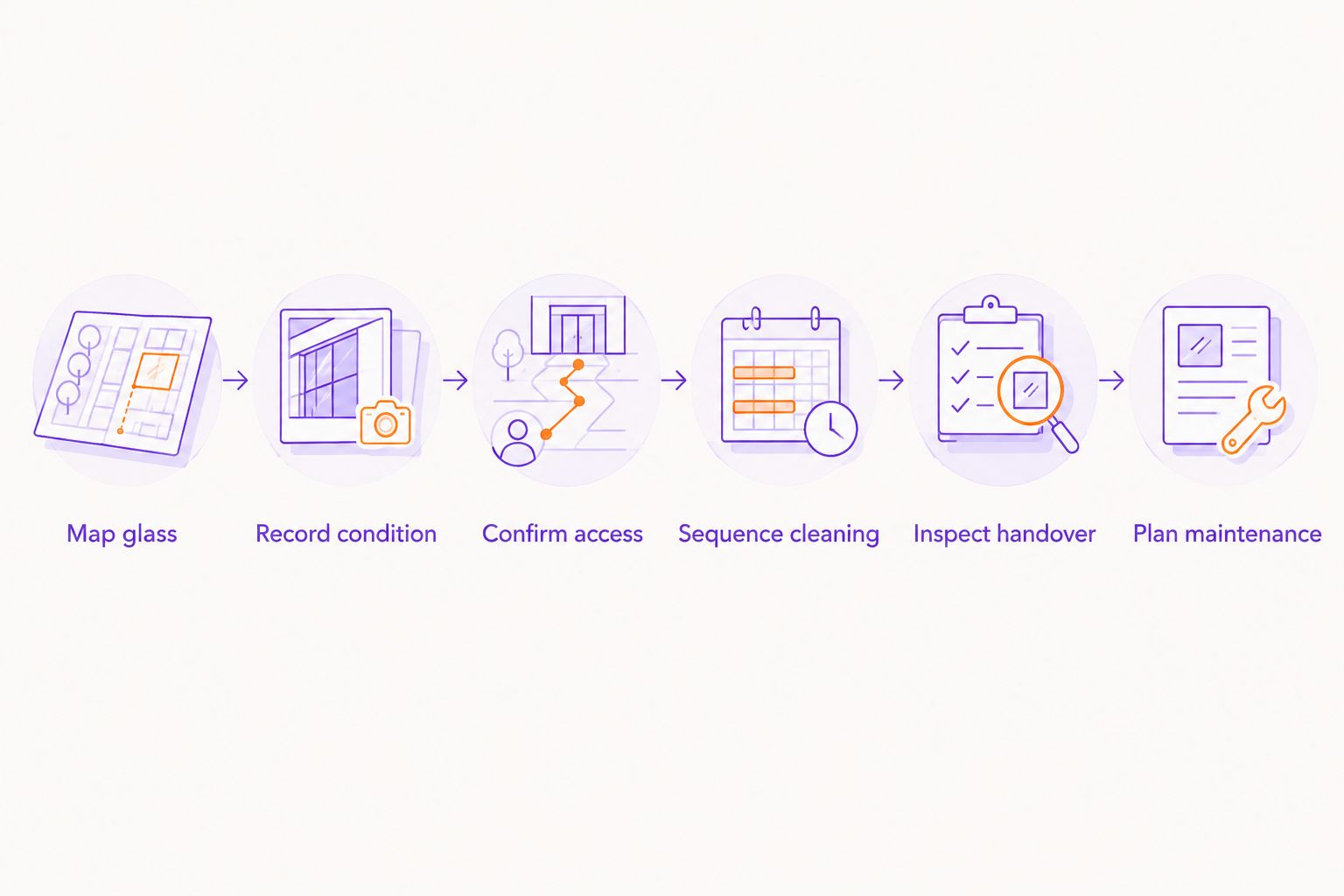
Inspect handover
Agree on acceptance before the cleaning starts. Specify the included surfaces, how you will inspect them, and how unresolved defects will be recorded. A clear checklist is more useful than a broad instruction to make the development look finished.
Use 2 inspection checkpoints: a pre-work condition review and a completion walkthrough. Compare the same locations at both checkpoints. This separates existing damage from remaining dirt and gives both parties a record of what was accepted.
For a 2026 phased development, inspect completed areas as they are released rather than waiting until the entire site is finished. Record exceptions with photographs and assign each one to cleaning, construction correction, or further assessment. Cleaning acceptance should not silently become acceptance of defective glazing.
- Inspect glass, frames, tracks, and sills against the agreed scope.
- Compare disputed marks with pre-work photographs.
- Record inaccessible areas rather than marking them complete.
- Assign an owner to each unresolved item.
- Save acceptance records with the handover documents.
Plan maintenance
Start with a simple maintenance register organized by building or tenant unit. Record the last accepted clean, known residue issues, access restrictions, and the person responsible for approving future work. Your property manager needs this information more than a generic instruction to keep the windows clean.
Choose the ongoing arrangement based on the property’s actual condition and operational requirements. The brand offers monthly storefront window washing, quarterly commercial window maintenance, and multi-property maintenance agreements. Those are service options, not evidence that every development needs the same interval.
For the 2026 operating plan, distinguish routine maintenance from tenant fit-out cleanup and restoration. New adhesive, paint, or construction residue should trigger a scope review rather than being added informally to a regular wash.
- Transfer the glass inventory and condition photographs.
- Record tenant access and approval requirements.
- Review recurring work against observed cleaning needs.
- Keep restoration tasks separate from routine washing.
- Assign responsibility for reporting new damage or deposits.
Compare cleaning options for your development
Choose a cleaning arrangement by the condition of the glass and the stage of the project. Routine washing and post-construction restoration solve different problems. Comparing them as interchangeable services hides exclusions and makes contractor proposals difficult to evaluate.
| Option | Best for | Practical advantage | Key limitation |
|---|---|---|---|
| In-house routine cleaning | Accessible glass with ordinary dirt | Direct coordination with your existing facilities team | Construction residue and difficult access need separate assessment |
| One-off commercial window washing | Completed properties needing a presentation clean | Defines a specific cleaning event around inspection or handover | Does not automatically include restoration or future maintenance |
| Post-construction glass restoration | Developments with adhesive, paint, silicone, or construction debris | Matches the scope to residue that ordinary washing does not address | Requires condition documentation and a suitable treatment method |
| Recurring commercial maintenance | Occupied storefronts and managed commercial properties | Gives the property manager an ongoing cleaning arrangement | Does not prevent re-soiling or replace construction cleanup |
| Texas Window Washing, LLC | San Antonio developers seeking cleaning, restoration, and later maintenance | Offers these service categories through a local provider | Project access, equipment suitability, and included tasks still require confirmation |
Ask every bidder to respond to the same glass inventory and condition record. Compare included surfaces, access assumptions, residue treatment, inspection arrangements, and exclusions. A short proposal can be clear, but a proposal that leaves these responsibilities undefined is difficult to enforce.
Keep the appointment decision separate from the acceptance decision. Selecting a contractor does not settle whether a particular pane needs routine washing, restoration, or glazing repair. Document those distinctions before the work begins.
Common mistakes developers make
Treating the final clean as an undefined allowance
A general cleaning allowance does not tell the contractor whether tracks, interior partitions, labels, or silicone are included. Attach a surface schedule and residue list. Approve a defined scope, not an undefined promise of clean glass.
Scheduling cleaning while dirty work continues
Cleaning before nearby painting, exterior washing, or fit-out work is complete creates a re-soiling dispute. Release work areas deliberately and document who authorizes repeat cleaning. A completion date without site-readiness criteria is not a workable sequence.
Assuming every elevation uses the same access method
A clear ground-level facade does not prove the next elevation has suitable access. Landscaping, setbacks, entrances, and interior restrictions all need review. Ask for an access plan tied to the actual building, not a general statement about tall windows.
Handing over clean glass without condition records
Once tenants and maintenance teams take control, undocumented marks become harder to assign. Transfer photographs, exceptions, and accepted work with the property records. Your maintenance contractor should not have to reconstruct the construction-stage condition later.
FAQ
What is commercial window cleaning for developers?
Commercial window cleaning for developers is the planned cleaning and detailing of development glass before handover and during property operation. Its scope should distinguish routine washing, construction residue removal, access requirements, and ongoing maintenance.
When should a developer schedule the final window clean?
Schedule the final window clean after nearby work that can dirty the glass is complete. Release each area with the superintendent and leave an opportunity for a completion inspection before handover.
Does commercial window cleaning include construction debris removal?
Construction debris removal belongs in the scope only when it is explicitly included. Identify paint, silicone, adhesive, stickers, and other residue separately so the contractor can assess the treatment method.
Who should inspect the windows before handover?
The developer’s designated representative and the cleaning contractor should inspect the completed work against the agreed scope. Include the superintendent or receiving property manager when that person is responsible for accepting the area.
Can Texas Window Washing, LLC clean hard-to-reach commercial glass?
Texas Window Washing, LLC offers hard-to-reach glass cleaning within equipment capabilities. Confirm the working method and access conditions for each elevation before including it in the appointment.
Is recurring window washing a replacement for post-construction cleaning?
Recurring window washing is not a replacement for post-construction cleaning. Maintenance addresses ongoing cleaning needs, while construction residue requires a separately defined assessment and scope.
What should developers include in a window cleaning request?
Include the glass inventory, interior and exterior requirements, condition photographs, access restrictions, and handover schedule. Identify restoration work and acceptance criteria so competing proposals address the same assignment.
One last thing
Ask what will happen if a marked pane does not come clean. Agree whether the next action is further cleaning, specialist assessment, or referral to the glazing contractor. That decision keeps an unresolved defect from being passed to the property manager as an unspecified maintenance task.
Related guides
- Post-construction cleaning companies in San Antonio
- Window cleaning for property managers in San Antonio
- Window cleaning for real estate agents in San Antonio