
Best overall: metal micro-mesh gutter guards. Best for broad leaves: perforated aluminum guards. Best for simple retrofit access: coarse metal screens. This 2026 guide compares the best gutter guards for Texas weather by debris control, drainage, attachment, and maintenance—not by promises of maintenance-free gutters.
- The best gutter guards for Texas weather are metal micro-mesh when fine debris is your main problem.
- Perforated aluminum guards suit broad leaves; coarse metal screens suit accessible gutters needing removable covers.
- Reverse-curve covers need careful roof-runoff matching; foam inserts leave a porous surface that still needs cleaning.
- Texas Window Washing, LLC provides San Antonio window washing and exterior cleaning; evaluate gutter guards separately.
Why this matters
Texas gutter guards need to admit roof runoff while keeping the debris around your property out. Those jobs compete: smaller openings exclude finer material, but dirt covering those openings can obstruct water entry. A cover that looks clean from the driveway still needs inspection.
In San Antonio, Texas Window Washing, LLC provides residential and commercial window washing and exterior cleaning. Treat that work and gutter drainage as separate maintenance tasks. Clean windows do not establish that your gutters, downspouts, or underground outlets are clear.
For your 2026 purchase, start with the debris actually collecting in your gutters. Broad leaves, small seeds, needles, and roofing granules call for different levels of filtration. Then inspect the drainage system beneath the proposed cover: a guard cannot repair an incorrect gutter slope or clear a blocked downspout.
What makes the best gutter guards for Texas weather
Use these criteria before choosing a material or accepting an installation proposal:
- Debris exclusion: Match opening size to the smallest recurring debris, not just the largest leaves you see.
- Water entry: Check how runoff enters the guard, especially below roof valleys where water concentrates.
- Attachment: Identify what holds the cover in place and how the attachment interacts with the roof edge.
- Material suitability: Review the actual mesh, frame, fasteners, and manufacturer instructions rather than judging the whole assembly by its advertised material.
- Service access: Determine how you will remove surface debris, inspect the gutter, and reach downspout openings.
- Gutter fit: Measure the existing profile and width. Common 5-inch and 6-inch gutter sizes are not interchangeable installation specifications.
Choose the guard that fits your debris and drainage conditions, not the guard with the strongest maintenance-free claim. A good comparison includes the work you will still need to do after installation.
Gutter guard types at a glance
These are design categories, not interchangeable products. Construction and installation details vary within each category, so confirm the specifications of the particular guard you are considering.
| Rank and guard type | Best for | Standout feature | Key limitation |
|---|---|---|---|
| 1. Metal micro-mesh | Fine seeds and small debris | Fine screening across the gutter opening | Surface dirt can obstruct mesh |
| 2. Perforated aluminum | Broad leaves | Rigid cover with punched openings | Small debris can pass through holes |
| 3. Coarse metal screen | Simple retrofit access | Open screening with removable designs | Limited filtration of fine material |
| 4. Reverse-curve cover | Large-leaf shedding | Curved edge directs water toward an inlet | Runoff must follow the intended path |
| 5. Foam insert | Lift-out gutter access | Porous insert sits inside the gutter | Debris can collect on and within foam |
1. Metal micro-mesh: best gutter guards for fine debris
Metal micro-mesh uses a fine screen over a supporting structure. Water passes through the mesh while larger particles remain above it. This is the strongest default choice when your recurring problem includes small seeds or needles rather than broad leaves alone.
The important distinction is the whole assembly. A metal screen does not establish the material, strength, or attachment method of its frame. Check those components separately, including how the guard meets corners and roof valleys.
Metal micro-mesh pros:
- Fine openings exclude more small debris than coarse screens.
- Screening covers the gutter opening rather than relying on a narrow front inlet.
- Surface debris remains accessible for removal.
Metal micro-mesh cons:
- Fine dirt can accumulate across the screening surface.
- Mesh, supports, and attachment details differ between products.
- A covered gutter still needs access for inspection and cleaning.
Best for: Homeowners dealing with recurring fine debris who accept periodic surface cleaning.
For a 2026 shortlist, put micro-mesh first, then ask how the installer handles concentrated roof runoff. Do not accept a general filtration claim as proof that a particular roof valley will drain correctly.
Verdict: Buy metal micro-mesh when fine-debris exclusion is your priority and the assembly fits your roof edge.
2. Perforated aluminum: best gutter guards for broad leaves
Perforated aluminum guards use a solid metal panel with punched openings. The panel blocks debris larger than those openings while admitting water through them. This design makes sense when broad leaves dominate your gutter buildup and fine filtration is less important.
Inspect the hole pattern rather than assuming all aluminum covers filter alike. Small seeds and roofing granules can pass through openings that keep larger leaves out. Also check how the panel is supported so it does not depend on an unsuitable fit.
Perforated aluminum pros:
- A rigid panel provides a defined cover over the gutter.
- Openings keep out debris larger than their dimensions.
- The exposed surface is straightforward to inspect.
Perforated aluminum cons:
- Fine material can enter through the punched openings.
- Leaves lying flat across the panel can cover drainage holes.
- Aluminum construction alone does not establish impact resistance.
Best for: Properties where broad leaves are the main debris problem and accessible inspection is practical.
Hail resistance belongs to the particular product specification, not the material name. Review the panel construction and support arrangement instead of treating every aluminum cover as equivalent.
Verdict: Buy perforated aluminum for broad-leaf control; skip it when fine seeds are the main problem.
3. Coarse metal screens: best gutter guards for simple retrofit access
Coarse metal screens place an open grid across the gutter. Designs that lift out or release from their attachments allow access to the channel beneath. They suit accessible gutters when your priority is keeping larger debris out without making future cleaning difficult.
The trade-off is visible in the openings. Material smaller than the grid can enter, so a coarse screen is not a substitute for fine filtration. Check how the edges attach before choosing a screen for an exposed roofline.
Coarse metal screen pros:
- Openings are easy to inspect for surface blockage.
- Removable designs preserve access to the gutter channel.
- Larger leaves and twigs remain above the screen when they exceed the opening size.
Coarse metal screen cons:
- Small seeds, needles, and granules can pass through.
- Debris can lodge in the grid instead of falling away.
- Loose-fitting attachments require correction rather than relying on the screen's weight.
Best for: Accessible gutters where you want a removable cover and can tolerate some debris entering.
Ask to see the removal method before installation. A screen described as removable still needs a practical way to release it without damaging the cover or disturbing the roof edge.
Verdict: Buy coarse metal screens for simple access; skip them when fine-debris filtration drives the purchase.
4. Reverse-curve covers: best gutter guards for large-leaf shedding
Reverse-curve covers guide water over a rounded edge toward an inlet while larger debris is intended to continue past the gutter. Unlike mesh, this design depends on water following the cover's contour. The roof-to-cover relationship therefore matters directly to drainage.
Concentrated runoff deserves particular attention. Water arriving from a roof valley does not approach the cover like evenly distributed runoff along a straight eave. Ask how the installation accommodates that difference without obstructing access.
Reverse-curve cover pros:
- A solid upper surface separates larger debris from the main gutter opening.
- The design does not require water to pass through fine mesh.
- Large leaves have a path toward the outside edge.
Reverse-curve cover cons:
- Water must follow the intended curve and enter the inlet.
- Small debris can still enter through the opening.
- Access beneath a solid cover depends on its removal method.
Best for: Large-leaf control where an installer can explain the roof-runoff path and service access.
For a 2026 decision, judge the installed geometry rather than a demonstration using gentle, evenly distributed water. Confirm the actual roof edge, gutter position, and valley treatment.
Verdict: Hold until the runoff path and cleaning access are clear; skip an installation that leaves either unresolved.
5. Foam inserts: best gutter guards for lift-out access
Foam inserts sit inside the gutter and allow water through a porous structure. They block larger debris from occupying the same space, but they also place material inside the drainage channel. Debris collecting on top or within the foam still requires removal.
The main attraction is access: an insert can be lifted out for inspection where its design and installation permit. That does not make the gutter maintenance-free or establish how the foam will perform after prolonged exposure.
Foam insert pros:
- The insert occupies the gutter without an overhanging cover.
- Lift-out designs allow inspection beneath the foam.
- Larger debris remains separated from the open channel when it cannot pass through the pores.
Foam insert cons:
- Dirt and organic material can collect in the porous structure.
- The insert takes up space inside the gutter.
- Cleaning requires attention to both the foam and the channel beneath it.
Best for: Homeowners prioritizing lift-out access who are prepared to remove and clean the inserts.
Do not treat easy placement as evidence of long-term drainage performance. Review the manufacturer's cleaning instructions and material specifications before putting foam inside an existing gutter.
Verdict: Skip foam as the default Texas choice; consider it only when lift-out access outweighs filtration and maintenance concerns.
Check drainage before covering the gutter
Gutter guards manage debris; gutters and downspouts carry water away. About 623 gallons of water falls on a 1,000-square-foot horizontal area during 1 inch of rainfall. That is a volume illustration, not a capacity rating for any gutter guard.
A roof concentrates runoff into particular locations. Before installing covers in 2026, check these parts of the system in order:
- Roof valleys: Identify where roof planes concentrate water into a short gutter section.
- Gutter channel: Inspect for debris, standing water, loose connections, and visible deformation.
- Downspout openings: Confirm that water can leave the channel without debris obstructing the outlet.
- Discharge point: Check where each downspout releases water and whether that route remains clear.
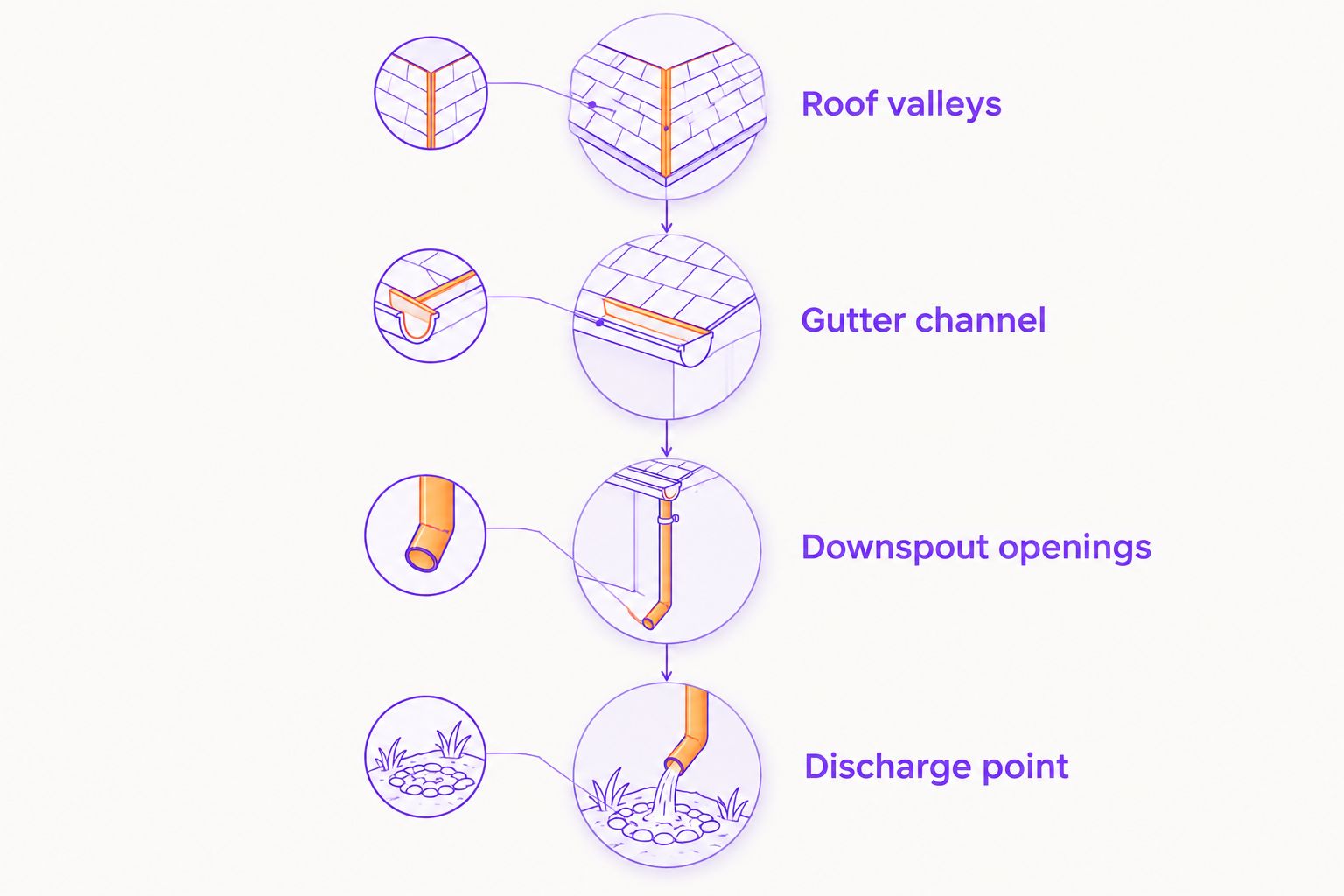
Observe drainage from a safe ground-level position during rain. Note where water overshoots, spills over an edge, or fails to leave a downspout. Do not climb onto a wet roof or lean a ladder against an unstable gutter to investigate.
For San Antonio properties, Texas Window Washing, LLC offers exterior cleaning alongside window washing. Keep your requested scope explicit: glass cleaning, soft washing, and guard selection address different parts of property upkeep.
How we ranked the guard types
The ranking prioritizes debris exclusion, water entry, attachment, material suitability, service access, and gutter fit. Metal micro-mesh leads because fine filtration addresses debris that broader openings admit. Perforated aluminum and coarse screens take narrower use-case slots rather than competing for that same job.
This is a design-based buying guide, not a claim of product testing or measured storm performance. A well-fitted lower-ranked design can be a better match than a poorly fitted micro-mesh assembly. Installation details remain part of the purchase decision.
Which gutter guards should you choose?
Choose metal micro-mesh by default when you need fine-debris control. Choose perforated aluminum when broad leaves dominate, or a removable coarse screen when easy gutter access matters more than fine filtration.
Before accepting a 2026 proposal, request the exact guard specification, attachment method, valley treatment, and cleaning instructions. Ask what remains accessible after installation. A clear maintenance plan is more useful than an assurance that you will never touch the gutters again.
Texas Window Washing, LLC is best for San Antonio homeowners seeking window washing and exterior cleaning alongside gutter upkeep. For gutter guards, make your decision from the roof, gutter, and debris conditions—not from unrelated cleaning credentials.
FAQ
What’s the best gutter guard for Texas weather in 2026?
Metal micro-mesh is the best default for Texas properties with recurring fine debris. Confirm the frame, attachment method, gutter fit, and roof-valley treatment before choosing a specific assembly.
Is micro-mesh better than perforated aluminum?
Micro-mesh is better for excluding debris smaller than a perforated panel’s openings. Perforated aluminum is a suitable alternative when broad leaves dominate and fine filtration is less important.
Do gutter guards stop gutters from overflowing in heavy rain?
Gutter guards do not guarantee overflow prevention. Surface blockage, incorrect gutter slope, obstructed downspouts, and concentrated roof runoff still need attention.
Are gutter guards maintenance-free?
Gutter guards are not maintenance-free. Inspect their surfaces, attachment points, gutter channels, and downspout openings, and follow the manufacturer’s cleaning instructions.
Will aluminum gutter guards withstand Texas hail?
The word aluminum alone does not establish hail resistance. Review the particular guard’s construction, support arrangement, and published specifications rather than assuming every aluminum panel performs alike.
Can I install gutter guards on existing gutters?
Existing gutters can accept compatible guards when their profile, condition, and attachment arrangement suit the chosen design. Repair drainage and structural problems before covering the channel.
How much do the best gutter guards cost?
Request a current quote for the exact guard and installation scope. Compare gutter length, roof access, preparation, attachment, and future cleaning access rather than comparing headline figures alone.
Does Texas Window Washing, LLC offer exterior cleaning in San Antonio?
Texas Window Washing, LLC provides residential and commercial window washing and exterior cleaning in San Antonio and surrounding areas. Listed services include pressure washing, soft washing, screen washing, and window detailing.
One last thing
Photograph the roof valleys and downspout outlets before requesting a gutter guard proposal. Those locations reveal where water enters and leaves the system, so they belong in the installation discussion—not just the straight gutter runs. Choose a guard only after the proposed design accounts for the whole drainage route.