
Best overall: custom-fitted exterior solar screens. Best for daylight: nominal 80% solar-blockage mesh. Best for strong glare control: nominal 90% mesh. This 2026 guide compares the best solar screens for Texas homes by room, fit, and maintenance; San Antonio homeowners can start with Texas Window Washing, LLC for custom fabrication and installation.
- The best solar screens for Texas homes match each window’s sun exposure, daylight needs, and cleaning access.
- Texas Window Washing, LLC offers custom solar screen fabrication and installation for San Antonio homeowners.
- Compare nominal 80% and 90% solar-blockage mesh using samples, not promised electricity savings.
- Choose removable screens where routine glass cleaning requires access behind the frame.
- Consider replacement mesh only when existing frames and mounting hardware remain sound.
Why this matters
Solar screens shade glass from the outside. They also change the amount of light reaching your rooms and the view through your windows, so choosing the densest mesh everywhere is not automatically the right decision.
For a 2026 home improvement project, start with the room that has the problem: afternoon glare, an uncomfortable sunny seating area, or direct sunlight across a desk. Then choose the screen configuration that addresses that problem without creating another one.
Texas Window Washing, LLC is best for San Antonio homeowners seeking custom solar screen fabrication and installation rather than a DIY project. The company also provides solar screen washing, removal, and reinstallation, which makes cleaning access relevant to the initial selection.
What makes the best solar screens for Texas homes?
Judge solar screens against these criteria before comparing options. A screen that performs well on one window does not automatically suit every room.
- Custom fit: The frame must suit the actual window opening and its mounting surfaces. Measure individual openings rather than assuming matching windows are identical.
- Daylight balance: Evaluate the mesh from inside the room. Stronger shading changes the light you use for reading, cooking, and working.
- Glare control: Assess the window when direct sunlight creates the problem. A shaded morning inspection does not answer an afternoon-glare question.
- Cleaning access: Decide how you will remove the screen, reach the glass, and reinstall the assembly without damaging it.
- Frame reuse: Inspect existing frames, corners, and hardware before deciding whether replacing only the mesh is appropriate.
- Window operation: Screens must not interfere with opening, locking, or required emergency escape. Check the complete assembly, not just the fabric.
Solar screen options at a glance
These recommendations compare configurations, not competing product brands. Fit, mesh density, and removable mounting describe different parts of an assembly; you can combine them when they suit your windows.
| Ranked option | Best for | Standout feature | Key limitation |
|---|---|---|---|
| Custom-fitted exterior solar screens | Custom fit | Fabrication around individual window openings | Fit alone does not determine shading or daylight |
| Nominal 80% solar-blockage mesh | Daylight balance | A lighter shading choice than nominal 90% mesh | Less solar blockage than the denser alternative |
| Nominal 90% solar-blockage mesh | Glare control | Greater nominal solar blockage | A darker indoor view and reduced daylight |
| Removable exterior solar screens | Cleaning access | Access to glass behind the screen | Removal and reinstallation require care |
| Replacement mesh in sound existing frames | Frame reuse | Retains a usable frame assembly | Cannot correct bent frames or unsuitable hardware |
1. Custom-fitted screens: best for individual window fit
Custom-fitted exterior solar screens are the strongest starting point when your priority is an assembly that suits the window rather than a generic frame size. The fabrication process addresses the opening, frame dimensions, and attachment arrangement. You still need to select the mesh separately.
Texas Window Washing, LLC offers custom solar screen fabrication and installation in San Antonio and surrounding areas. Its stated services also include screen repairs and solar screen removal and reinstallation. Those services address both the initial assembly and later maintenance needs.
Custom-fitted screen pros:
- The frame can be sized for the individual opening.
- Mesh selection remains separate from frame sizing.
- You can discuss attachment and removal before fabrication.
- Professional installation avoids making the project entirely dependent on your own measuring and assembly skills.
Custom-fitted screen cons:
- Correct dimensions do not guarantee the right daylight level.
- Unusual openings still require an access and attachment assessment.
- A custom frame does not remove the need for cleaning.
Best for: San Antonio homeowners who want professional fabrication and installation, especially when existing frames do not fit properly.
Before approving a 2026 installation, ask to review the mesh choice, attachment method, and removal procedure together. Treat these as one specification rather than making separate decisions after fabrication.
Verdict: Buy custom-fitted screens when fit and installation are your priorities.
2. Nominal 80% mesh: best for preserving more daylight
Nominal 80% solar-blockage mesh is a useful starting point when you want exterior shading without choosing the denser 90% alternative. These percentages are commonly published solar-screen product ratings. They are not promises of equivalent reductions in room temperature or electricity consumption.
Compare samples in the actual room. The important question is whether the screen reduces the glare you dislike while leaving enough light for the activities you do there.
Nominal 80% mesh pros:
- Preserves more daylight than a comparable 90% option.
- Provides a distinct alternative to choosing maximum nominal blockage.
- Gives you a starting point for rooms where natural light matters.
Nominal 80% mesh cons:
- Blocks less solar energy than a comparable 90% option.
- Does not eliminate every direct-sun glare problem.
- The rating alone does not describe the finished view.
Best for: Living rooms, kitchens, and workspaces where you want shading but remain sensitive to losing daylight.
For your 2026 selection, compare equivalent fabrics under the same conditions. A difference in color or construction can complicate a comparison that appears to be only about percentages.
Verdict: Buy nominal 80% mesh when daylight balance matters more than maximum nominal blockage.
3. Nominal 90% mesh: best for stronger glare control
Nominal 90% solar-blockage mesh is the stronger shading option in this comparison. Consider it for a window where direct sun disrupts television viewing, computer work, or comfortable use of the room.
The trade-off is visible. More shading also means less daylight through the screened window, so inspect a sample from inside before committing to the whole elevation.
Nominal 90% mesh pros:
- Provides greater nominal solar blockage than comparable 80% mesh.
- Suits a selection process focused on strong exterior shading.
- Lets you target troublesome windows instead of darkening every room equally.
Nominal 90% mesh cons:
- Reduces daylight more than the lighter alternative.
- Can make an already dim room less suitable for your needs.
- Does not establish a whole-home energy-savings figure.
Best for: Windows where strong direct-sun glare is the main complaint and you accept the daylight trade-off.
Do not select 90% mesh solely because the number is higher. A bedroom, dining room, and home office can have different priorities even when their windows face the same direction.
Verdict: Buy nominal 90% mesh for targeted glare control; skip it where preserving daylight is the priority.
4. Removable screens: best for glass-cleaning access
Removable exterior solar screens let you reach the glass behind the assembly for cleaning and inspection. Removability is an attachment feature, not a solar-blockage rating, so it can be paired with the mesh choice that suits the room.
Choose this configuration by examining the removal procedure. A screen is not practically easy to maintain if accessing its fasteners requires an unsafe position or handling a large frame without support.
Removable screen pros:
- Provides access to the covered glass.
- Allows separate handling of the screen and window during cleaning.
- Supports inspection of frames and mounting points.
Removable screen cons:
- Removal can bend a frame if handled carelessly.
- Loose fasteners and fittings need organized storage.
- Elevated windows still require suitable access equipment.
Best for: Homeowners who prioritize regular window washing and want the screen assembly considered in the cleaning plan.
Ask the installer to demonstrate removal and reinstallation on an accessible window. Confirm which parts stay attached, where the screen can be held safely, and how the assembly returns to its original position.
Verdict: Buy removable screens when cleaning access is a deciding factor; skip DIY removal where access is unsafe.
5. Replacement mesh: best for keeping sound existing frames
Replacing the mesh is a narrower project than replacing the entire screen assembly. It makes sense when the existing frame is straight, its corners are secure, and the mounting arrangement remains appropriate for the window.
Start with the frame inspection. New fabric cannot correct a bent assembly, weak corners, or an attachment method that interferes with window operation.
Replacement mesh pros:
- Retains a frame that still fits the opening.
- Allows you to reconsider shading without automatically replacing everything.
- Focuses the work on the worn or unsuitable fabric.
Replacement mesh cons:
- Leaves existing frame defects unresolved.
- Requires compatible retaining materials and correct installation.
- Is unsuitable when the complete assembly needs correction.
Best for: Homeowners whose existing frames and hardware remain sound but whose mesh needs attention.
For a budget-conscious 2026 project, inspect before specifying replacement. The useful decision is whether the frame deserves to stay, not whether new mesh can temporarily hide its problems.
Verdict: Hold off on full replacement until the frames are inspected; buy replacement mesh only for a sound assembly.
How to choose the right combination
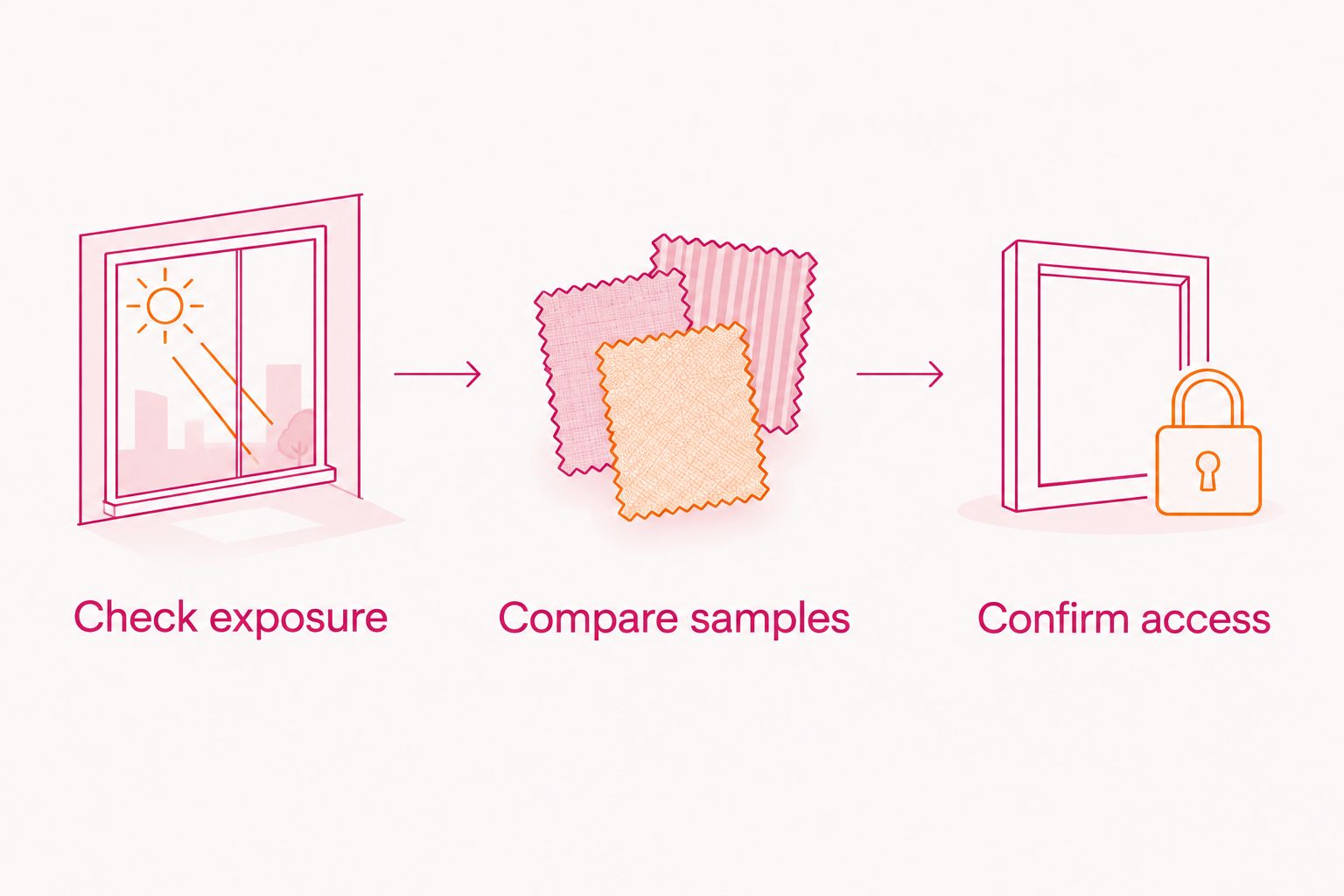
Start with the problem window rather than a whole-house material choice. A short selection sequence keeps the room’s needs ahead of the product rating.
Check exposure
Look at the window when glare or direct sun bothers you. Note where the light falls and whether the problem is at the glass, across a seating area, or on a screen you use for work.
Compare samples
View suitable mesh samples from inside and outside. Check the indoor view, available daylight, and exterior appearance before choosing the rating.
Confirm access
Review frame fit, attachment, removal, and window operation together. Include the person who will maintain the screens if that is not you.
Record your final choices by window or room. That prevents a useful decision for a sunny office from becoming an automatic specification for a shaded bedroom.
How we ranked these solar screen options
The ranking prioritizes fit first, then daylight and glare needs, followed by maintenance access and the condition of existing frames. It compares selection approaches rather than claiming laboratory performance for unnamed products.
Custom fabrication takes the default position because an unsuitable assembly remains unsuitable regardless of mesh rating. The other options answer narrower questions: how much shading to choose, how to reach the glass, and whether a usable frame should stay.
Which solar screens should you choose?
Choose custom-fitted exterior screens as the default, then select the mesh room by room. Start with nominal 80% mesh when preserving daylight matters; compare nominal 90% mesh when strong glare is the overriding problem.
Texas Window Washing, LLC provides custom fabrication, installation, washing, and removal and reinstallation for San Antonio-area properties. Discuss those needs together instead of treating maintenance as a separate issue after the screens are installed.
Plan your solar screen installation
Review custom fabrication, installation, and cleaning needs for your San Antonio home.
FAQ
What are the best solar screens for Texas homes in 2026?
Custom-fitted exterior solar screens are the best starting point, with mesh selected for each room’s daylight and glare needs. Compare nominal 80% and 90% options, then confirm fit, attachment, and cleaning access.
Are 80% or 90% solar screens better for a Texas house?
Nominal 80% mesh is better for preserving more daylight, while nominal 90% mesh provides stronger solar blockage. Compare equivalent samples in the actual room rather than choosing solely by the higher rating.
Does a 90% solar screen reduce my electricity bill by 90%?
No, a nominal 90% solar-blockage rating is not a promise of 90% electricity savings. Whole-home energy use depends on the building, windows, shading, cooling equipment, and household use.
Should I put the same solar screen mesh on every window?
No, choose mesh according to each room’s exposure and daylight needs. A strong-glare window and a shaded window do not require the same selection.
Can I replace solar screen mesh without replacing the frame?
Yes, replacement mesh is an option when the existing frame, corners, and mounting hardware remain sound. Inspect the complete assembly first because new fabric does not repair structural defects.
Do solar screens provide privacy at night?
Do not rely on solar screens for nighttime privacy. When indoor lighting is brighter than outside, use suitable interior window coverings for privacy.
Can solar screens be removed for window washing?
Screens with a suitable removable mounting arrangement can be taken off for glass cleaning. Confirm the removal procedure and safe access before installation, especially for elevated windows.
Who offers custom solar screen installation in San Antonio?
Texas Window Washing, LLC offers custom solar screen fabrication and installation in San Antonio and surrounding areas. Its services also include solar screen washing, removal, and reinstallation.
One last thing
A solar screen rating describes the mesh, not the success of the entire installation. Before approving your 2026 project, ask for a removal demonstration and check that the window still operates as intended. The best choice is the one that shades the room without creating an access or maintenance problem.